
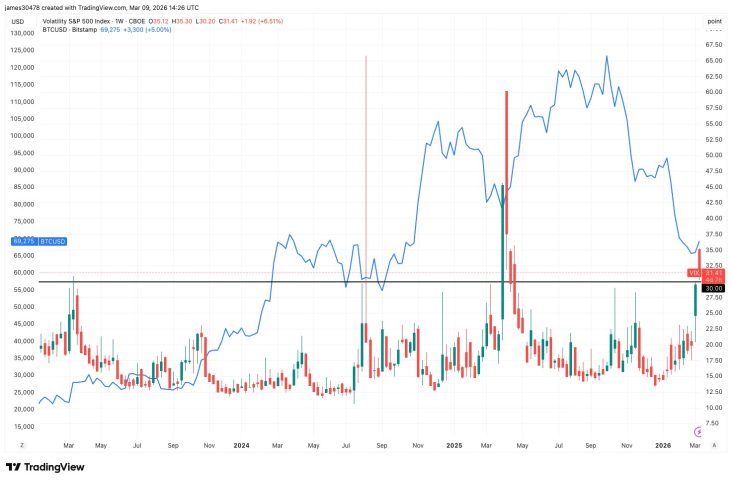
Global financial markets are experiencing a fresh wave of uncertainty as stock market volatility has climbed to its highest level in more than a year. The surge in volatility — often measured by indicators like the VIX, widely known as Wall Street’s “fear gauge” — reflects growing investor anxiety about macroeconomic conditions, geopolitical tensions, and shifting monetary policies. Interestingly, this spike in market fear may also provide a potential clue about the future direction of Bitcoin.
Historically, periods of extreme volatility in traditional financial markets have coincided with important turning points for risk assets, including cryptocurrencies. Analysts note that large spikes in the VIX often occur near major market bottoms. When fear reaches extreme levels, many investors panic-sell assets, creating conditions where prices become deeply oversold. This environment can eventually attract long-term buyers looking for value.
Bitcoin appears to be showing signs of resilience during this period of turbulence. Despite heavy selling pressure across equities and commodities, the leading cryptocurrency has managed to stabilize around the mid-$60,000 to $70,000 range in recent trading sessions. This relative stability suggests that the market may already have absorbed much of the negative sentiment that triggered earlier declines.

Market analysts point out that volatility metrics within the crypto ecosystem also tell an interesting story. Bitcoin’s own volatility indicators spiked earlier this year, signaling that the market may have already experienced the worst of its panic phase before traditional markets reacted. If this pattern holds true, Bitcoin could be closer to forming a local bottom than many investors expect.
Another key factor supporting the bottoming theory is the growing relationship between Bitcoin and traditional financial markets. As institutional investors increasingly participate in crypto trading, Bitcoin’s behavior has become more connected to macroeconomic signals such as stock market volatility, interest rates, and global liquidity conditions. When fear in equity markets peaks, it often marks a moment when risk assets begin stabilizing and preparing for a rebound.
Geopolitical developments have also played a role in recent volatility. Tensions in the Middle East and sharp movements in oil prices have shaken global markets, triggering declines in stocks and sudden shifts in investor sentiment. Yet Bitcoin has remained relatively stable compared with many traditional assets, reinforcing the view among some analysts that it could benefit if macroeconomic conditions begin to stabilize.
At the same time, traders remain cautious. A spike in volatility does not guarantee an immediate recovery. In some cases, markets can remain turbulent for weeks before a clear trend emerges. Key upcoming economic events, including inflation data releases and central bank policy decisions, could still influence the direction of both stock markets and cryptocurrencies.
For Bitcoin investors, however, the current environment may represent a critical moment. If historical patterns repeat, the rise in stock market volatility could signal that the worst of the sell-off is nearing its end. While uncertainty remains high, the conditions that typically precede a market bottom — extreme fear, high volatility, and cautious sentiment — appear to be forming across global markets.
In the volatile world of crypto, such moments often become the foundation for the next major move. Whether Bitcoin ultimately confirms a bottom in the coming weeks remains to be seen, but the signals emerging from traditional markets suggest that the groundwork for a potential recovery may already be underway.